
Research Highlights
This page highlights selected research projects and the associated publications for which I served as the first author and/or corresponding author.
2025
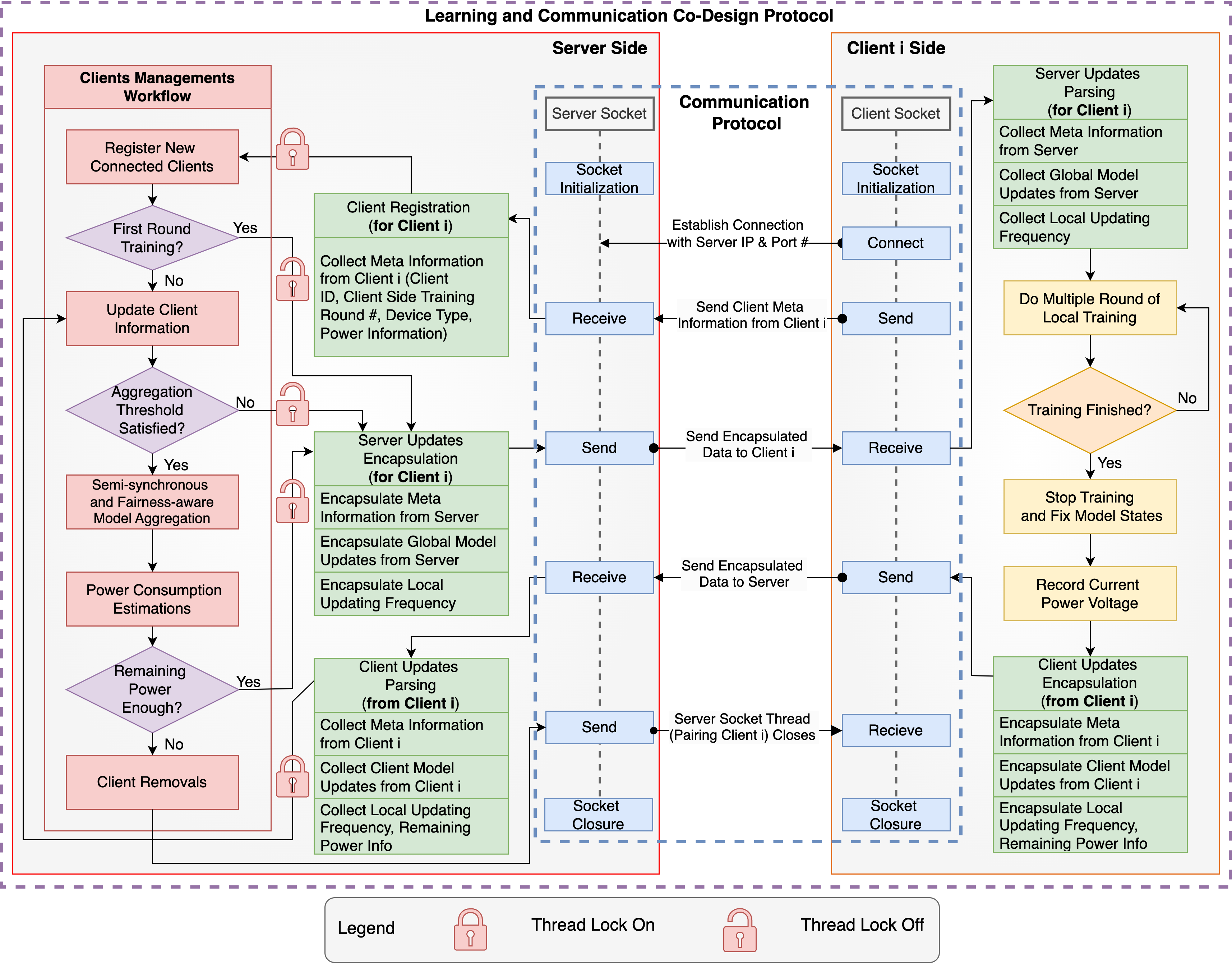
SPFERE: Towards Practical Semi-Synchronous On-Device Federated Edge Learning With Fairness and Power Awareness
Accepted to IEEE Transactions on Mobile Computing
In this work, we propose SPFERE, a Semi-synchronous Power-aware and FairnEss-Regulated Engine, designed for power-constrained edge environments and implemented on a real-world edge testbed to support asynchronous model updating, power management, and fairness-aware model aggregation. Specifically, we propose a client grouping-based semi-synchronous aggregation protocol that reduces idle waiting time for power-abundant devices and mitigates stale updates from power-constrained devices, along with our in-depth convergence analysis. Then, we introduce a long short-term memory (LSTM)-based power estimation approach to predict remaining battery voltage for devices with limited communication overhead, enabling early warnings for power dropouts. Lastly, we design fusion-based fairness-aware model aggregation methods to prevent bias by considering device participation frequency and training workload.
📄 Paper: IEEE Xplore Link
💻 Code: GitHub Repository Link
🎥 Demo Video: YouTube Demo Link
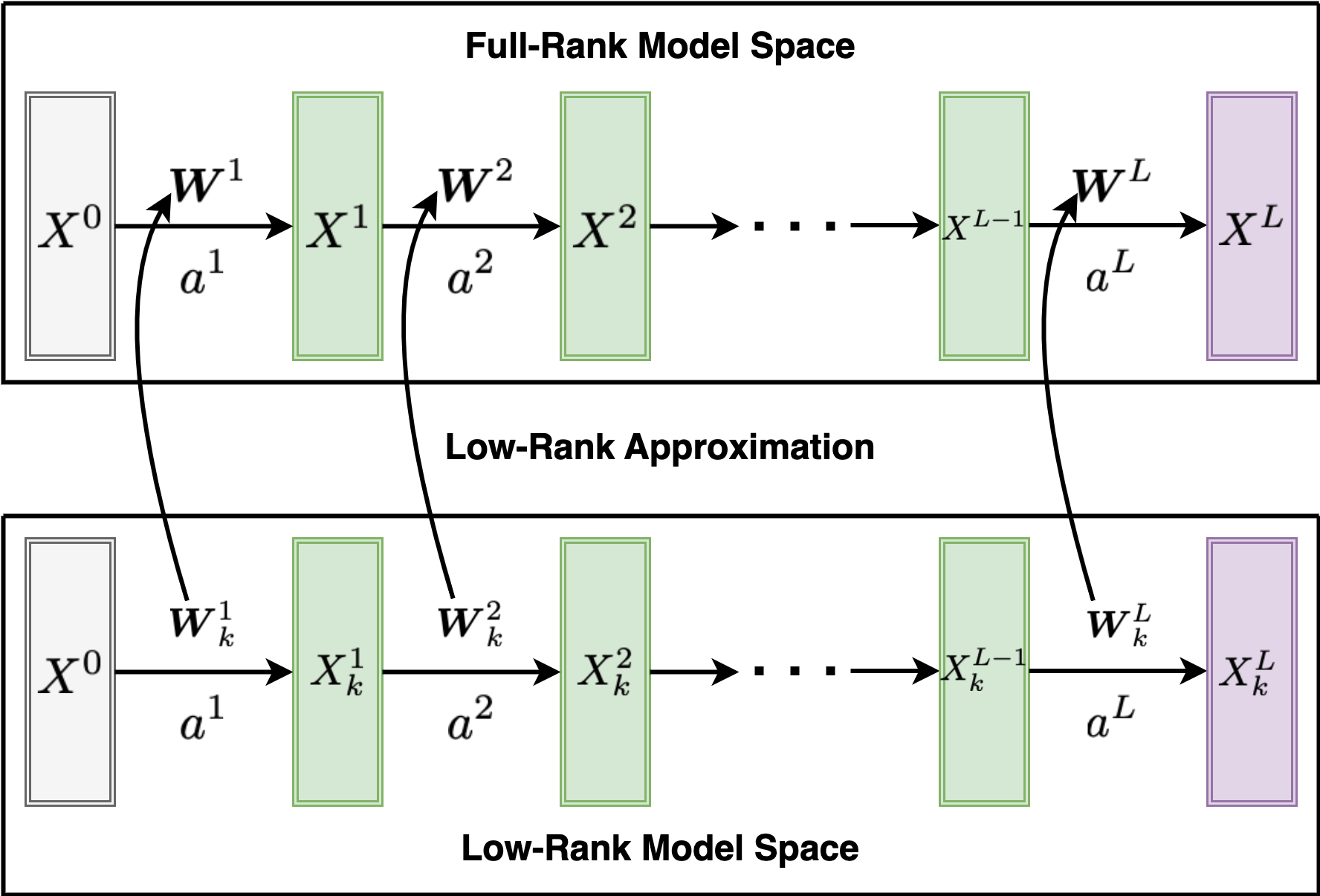
Integrating Independent Layer-Wise Rank Selection with Low-Rank SVD Training for Model Compression: A Theory-Driven Approach
Accepted to Proceedings of the Thirty-Fourth International Joint Conference on Artificial Intelligence (IJCAI’25)
In this paper, we design a novel approach by integrating rank selection into the lowrank training process and performing independent layer-wise rank selection under the guidance of a theoretical loss error bound. Specifically, we first conduct a comprehensive theoretical analysis to quantify how low-rank approximations impact the training losses. Building on these insights, we develop an efficient layer-wise rank search algorithm and seamlessly incorporate it into low-rank singular value decomposition (SVD) training.
📄 Paper: Paper(PDF)
📌 Poster: Poster(PDF)
📎 Appendix: Appendix(PDF)
2024
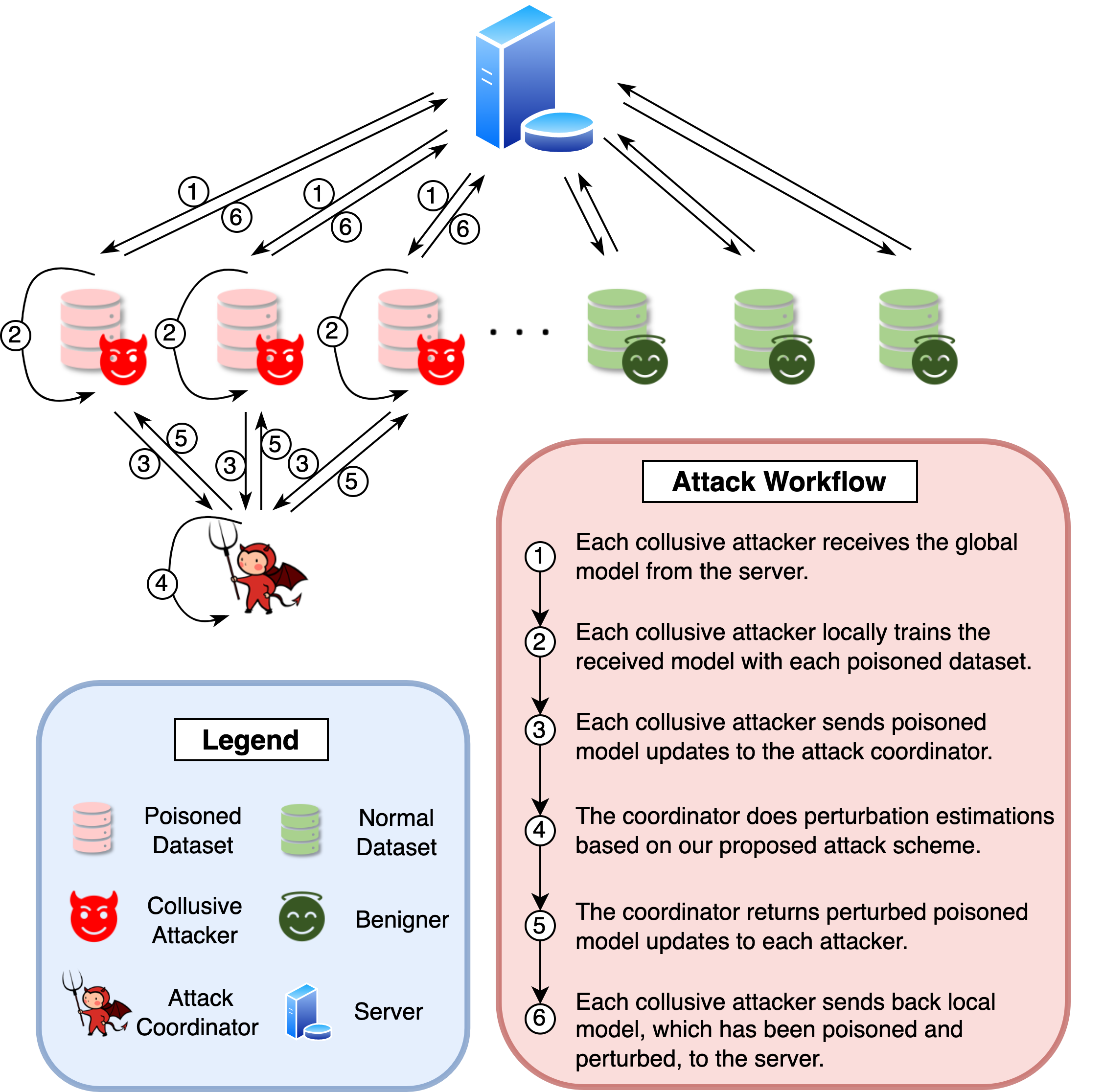
Collusive Backdoor Attacks in Federated Learning Frameworks for IoT Systems
Accepted to IEEE Internet of Things Journal
In this article, we propose a novel attack approach, called collusive backdoor attacks (CBAs), which bypasses robust aggregation defense by considering both local backdoor training and post-training model manipulations among collusive attackers. Particularly, we introduce a nontrivial perturbation estimation scheme to add manipulations over model update vectors after local backdoor training and use the Gram-Schmidt process to speed up the estimation process. This makes the magnitude of the perturbed poisoned model to the same level as normal models, evading robust aggregation-based defense while maintaining attack efficacy. After that, we provide a pilot study to verify the feasibility of our perturbation estimation scheme, followed by its convergence analysis.
📄 Paper: IEEE Xplore Link
📊 Talk Slides: Slides(PDF)